Adults are meditating more. In fact, a 2017 survey found that the number of adults that meditated in a previous 12-month period rose from 4.1% in 2012 to over 14.2% in 2017. If you want to start on your own path to mindful living but can’t seem to find the motivation, the benefits of group meditation may help.
Why?
The science behind meditation is promising and you don’t need to spend a dime. You can meditate with friends, family or, if you wish, you can also go to an official meditation group in your area that will cost money.
But today, we’ll outline why group meditation may be good for you (it’s definitely not for everyone). However, if the practice of meditation is something you’re interested in but you can’t seem to fit it into your daily rituals, regular practice in a group setting will definitely help.
7 Benefits of Group Meditation
1. Group Meditation Keeps You Motivated
A lot of people practice mindfulness and meditation on their own. For me, personally, I prefer to meditate outside of a group setting. I find groups make me feel self-conscious, and then I rely too much on the group.
However, studies on doing activities in groups indicate that a group setting can lead to:
Intrinsic motivation
Greater consistency
Enhanced social skills
Boosted engagement
Stanford conducted a study on motivation, which shows how group exercises work well. Many of these will translate to group meditation benefits, although the study was not based on meditation.
Note: Group meditation may or may not be for you. If you find that you’re 100% reliant on the group and if the group disbanded you wouldn’t meditate on your own, this can be detrimental to your practice. For example, many people do this with the gym. They’ll find a partner, stay motivated and never go when their partner isn’t there. Don’t become too reliant on one person as the reason for attending a mindfulness meditation group.
2. Meet Like-minded Friends
Socialization is another reason to join in group activities. If you want to expand your friend circle or get to know like-minded people in your area, group meditation may be a good option for you.
However, there are a few points to remember here:
Don’t try talking to anyone in the middle of the class
Get to the meditation early if you want to mingle
Be mindful that some people may not be there to socialize
Finally, we’re going to go deeper into the benefits of group meditation to see how meditation can help your emotional and physical health.
3. Reduce Stress Levels
Stress is a part of life. Right? If you’re alive, there’s always some sort of stress each week. Perhaps you’re stressed about work, money, relationships, or someone being sick – there are many reasons to be stressed.
However, did you know that meditation reduces stress?
In fact, a mindfulness-based meta-analysis of 209 studies found that meditation can help improve quality of life by significantly reducing:
Stress
Anxiety
Depression
With that said, don’t expect to experience this benefit immediately during your first group session unless you know how to meditate properly. Often, you’ll meditate for the first time and fall asleep, or you may start worrying about your focus, which is jumping to everything from what you’re going to eat for dinner to work.
If you want to reduce your stress by meditating, be sure to give it multiple sessions.
You won’t instantly feel the weight of the world lift off of your shoulders after a single group meditation. But, over time and with weekly or daily meditation practice, your stress levels will eventually fall.
4. Lower Your Blood Pressure
One of the main benefits of meditation is reducing blood pressure. You can achieve this through multiple meditation styles, but mindfulness meditation works exceptionally well for lowering blood pressure.
2012 review found that in people with high blood pressure, meditation could reduce both SBP and DBP.
2019 study involving 2 hours of meditation each week for eight weeks found that participants who meditated had lower DBP, resting BP and SBP levels.
We’re not saying that you’ll avoid heart disease or a heart attack by meditating, but you can reduce your blood pressure and stress.
In fact, if you read through the studies linked above (please do, they’re great resources), you’ll find that there are small or modest reductions that researchers state are meaningful.
5. Learn How to Meditate With a Leader
If you’re just learning, join a class that is being taught by a meditation expert. Many classes are thrown together by friends or someone that likes the aspects of meditation but isn’t an expert.
And there is nothing wrong with these classes and they are many people’s first meditation experience.
However, if you’ve never taken meditation courses before or need a little extra guidance, a group meditation class guided by an expert is ideal.
If you have trouble staying focused at work or in your general life, meditation can help. Oftentimes, people meditate to:
Relieve stress
Blast away anxiety
Clear their mind
And when you’re not stressed or anxious, you’ll be more productive. However, you may want to try transcendental meditation if you want to be more productive. Studies show that this form of meditation works well for productivity and also helps people relieve job tension and anxiety.
One thing to note is that regular meditation is key to enhancing your productivity.
Don’t expect your productivity to soar after one or two meditation sessions.
7. Blast Away Anxiety
Do you have anxiety? If so, you’re not alone. 40 million people in the US alone have anxiety. Meditation has been thoroughly studied for its impact on anxiety.
A 2010 meta-analysis of 39 studies found that mindfulness meditation provided moderate anxiety relief in people that didn’t have mood disorders. However, individuals who entered the studies with mood or anxiety disorders experienced a much higher rate of anxiety reduction.
If you have general anxiety disorder (GAD), this 2013 study is what you want to read. Researchers found that in people with GAD, anxiety levels fell after meditating. Stress levels also fell after meditating for this group.
What About Online Group Meditation Benefits?
Online group meditation also offers the same benefits. In fact, if you can’t find the time to join a group near you, don’t want to deal with the traffic or simply rather try meditating online, you should.
A few of the great benefits of an online meditation group are:
Many groups are free
Join groups from leaders worldwide
Classes at varying times of the day and night
No need to drive or deal with traffic
And, you’ll also experience the same great group meditation benefits listed above from the comfort of your own home. That’s the magic of meditation: you can meditate wherever you are in the world.
If you want to experience the benefits of group meditation, join a local class, lead a group meditation class yourself or attend one online. And if you have friends interested in joining a meditation session, start your own group among friends.
Together, you’ll experience the effects of meditation while strengthening your friend circle in the process.
PS: Group meditation is just one method of meditation. You can find dozens of different forms to practice, including two which we recently wrote about: mantra meditation and candle meditation.
Approximately 98% of universities offer online classes, and roughly 50% of professors approve of virtual schools. The pandemic helped create a cosmic shift in the way people learn, but one issue remains: how to stay focused during online school.
And when I use the term “school,” this can mean:
Online classes for:
K – 12
College
Work
Online courses
Corporate training / education
Any type of distance learning
Unfortunately, many ways to stay focused in school don’t translate to online learning. For example, paying attention in class is easier for many people because an instructor will make sure they’re not on your phone, running to the refrigerator to grab a snack, playing video games or petting their dog.
Virtual classes give you a lot of freedom, but if you think back to your education, you’ll often find no one really teaches you how to stay focused while studying.
In fact, you never really learn how to learn.
If you want to learn how to learn, there’s a great, free class on the subject on Coursera called: Learning How to Learn: Powerful mental tools to help you master tough subjects. Barbara Oakley does a fantastic job instructing the class, and I’ve personally enjoyed it.
However, today we’re going to hone in on how to pay attention in online classes. We’re going to go through tips to stay focused, how not to get distracted during online school and actionable methods that you can apply to your learning today that will make a dramatic difference in your learning.
How to Stay Focused During Online School Using 9 Simple Hacks
1. Create a Dedicated Study Space
Online students are slowly retraining themselves on how to learn virtually. Want to know how to stay focused on studies? Create a dedicated space. Think of your actual class environment. What does it have?
A desk or some place to take notes and open a book
Organization, primarily because the desk is empty
No clutter
Ideally, you’ll want to pick a room or space in your home where you have everything you need to learn. Notebooks, pencils, pens, organization tools and not much else. Your space should be clear of clutter and have the main goal of making it easy to learn.
If your space is cluttered, your mind will be cluttered.
2. Set Daily Schedules
Many people never truly learn how to stay focused in class because they allow themselves too much freedom. For example, a student in high school isn’t likely to create a strict class time, which includes:
Class schedule
Study schedule
Instead, they’ll give themselves little time to focus on schoolwork, cram everything in at the last minute and hope for the best.
Unfortunately, a lot of students do well with this last-minute hustle.
However, if you can’t focus on online classes, it’s eventually going to lead to poor study habits. You should create a schedule that works well for you, and your schedule can even evolve. For example:
Monday: Class from 9am to 10:30am; Study time from 6pm to 7pm
Tuesday: Class from 10am to 10:30am; Study time from 3pm to 4pm
One of the best things about remote learning is that focus time can often revolve around your schedule. Sure, if you have strict class start times, you may have less freedom to choose when to go to class, but you’ll always have the freedom to study on a schedule conducive to your type of learning.
You need to get to bed on time, wake up on time and remain consistent. In fact, studies show that your brain works to store external stimuli when you sleep. If you’re not sleeping enough, you’re hindering your brain’s ability to store the information you learn.
3. Create Daily Checklists
Many teens want to know how to stay focused in high school, and one of the best methods is to make daily checklists. If you’re in college, university, taking an online class for leisure or work or anything else, these same to-do lists will work great.
Simply:
Create a list of things you need to get done
Sort your list by each task’s priority
You may list everything from making coffee before class to mental breaks, study breaks, showering, etc.
If you have a daily checklist of all of the major tasks that you need to complete, it will make your day – and learning – much easier.
4. Block Background Noise
If you’re at home and hear someone else in the house talking or watching their favorite television show, it’s going to be very distracting for you. White noise is an excellent option because it will block noise so that you can focus on learning.
However, you need to find a way to block background noise for yourself.
Learning styles are different, so you may find that you’re best able to block noise with:
Earphones
Noise blocking headphones
Classical music
White noise
Simply find a way to ignore the noise and focus on your academic success.
5. Use Offline Tools
Education really has two parts:
Instruction
Studying
Your professor or teacher may spend an hour teaching you a subject that you study for four hours on your own. A major issue when people learn how to focus on online school is that they do everything online.
By everything, this means that they take all of their notes online, study online and go to class online.
If the Internet is down for a few hours, they shrug and just skip the day’s learning. You should be utilizing offline tools to help you study, too. A few of these tools are:
Physical notebooks
Books
Stored media (offline mode)
In fact, a 2009 study suggests that handwriting may provide better recognition and recall than typing. Brain imaging seems to back this theory, too. So, if you’re taking notes online, it may be beneficial to start writing these notes out for better recall and also to use them offline, too.
How To Focus on Online Classes by Eliminating Distractions
When first researching how to stay focused during online school, it was apparent that time management and eliminating distractions would be crucial to your success. As someone that has been running a business from their house and learning online for over 10 years, I have a lot of firsthand experience on distractions.
And while I don’t have an answer for a needy dog wanting to play catch midday, I do have a few great, personal tips on eliminating distractions for long periods of time.
A few of the tips that work well for me to get rid of distractions are:
6. Create a No Person Allowed Space
Distractions are often associated with notifications on your phone, but some of the main distractions exist right in your home. For example, dogs, kids, parents, spouses and everything in between can become a distraction.
Actually, procrastination plays a major role in these distractions, too.
If you don’t want to log into your online class, you’ll decide it’s a great time to go ask a random question to anyone in the house.
However, you’re just putting off the inevitable and will need to go back to studying eventually. One method that works wonders for getting rid of distractions when studying is to make your designated study area your own space.
No one is allowed in this space while you’re studying.
Put a sign on the outside of the door. Lock the door. Do whatever it takes to keep other people from distracting you while you’re learning online.
7. Block Non-essential Notifications
Notifications on your phone, and to a lesser extent your computer, are going to be very distracting. The average person receives over 63 notifications a day, and if you’re trying to get anything done, you’ll quickly find that your productivity rate plummets from a single notification.
A few ways to block notifications are:
Turn your phone on airplane mode
Turn off all notifications
Use an app
Turn on Do Not Disturb Mode
Blocking notifications will allow you to focus on online courses and school.
8. Block Distracting Websites
One of the best tips for how to stay focused at workalso applies to learning online: block distracting websites. There are numerous, technical ways to do this, but one of the easiest methods is to use a browser extension.
If you don’t see the browser you use listed above, you’ll surely find equivalent options available.
9. Block Social Media Channels
Social media wastes 145 minutes of people’s time per day. Imagine your boss or teacher telling you that you need to spend 2 hours and 25 minutes of your day doing more work. Instead, you’re losing this same amount of time on social media.
Using the same extensions above, you’ll want to block all, non-essential social media channels.
By non-essential, we mean any social media channel you’re not using for school or your course. Additionally, you’ll want to shut off notifications on your phone or simply turn it upside down while you’re studying.
Figuring out how to stay focused during online school or classes takes a lot of time and effort. Everyone has a different attention span and learns in their own unique way. However, the tips above are a good starting point that you can build off to find your own ways to stay focused when learning online.
If you’re having trouble falling asleep at night, you’re not alone. An estimated 70 million Americans have chronic sleep issues. The problem isn’t necessarily a medical one (although it can be). In many cases, it’s just a matter of learning how to wind down for the night and establishing a healthy sleep routine.
If you’re not sure where to start, we have some simple tips to help you relax before bed. Winding down for the night isn’t as hard as it seems!
14 Ways to Wind Down for the Night
1. Disconnect from Social Media
If you want to wind down before bed and calm your mind, disconnect from social media. Close out Instagram, Facebook, Twitter and whatever other social media apps you use for the night.
Here’s why social media is sabotaging your sleep:
Smartphones emit blue light that messes with your body’s production of melatonin and your circadian rhythm. When your sleep-wake cycle is out of whack, it’s harder to fall asleep and wake up in the morning.
Social media keeps your mind stimulated. Whether you’re chatting or just scrolling, the content you see will keep your mind going.
To give your mind a chance to settle down and relax, try closing out all social media apps an hour or two before bed. If you’re used to scrolling or chatting before bed, try doing one of the other relaxing activities on our list instead.
2. Diffuse Essential Oils
Aromatherapy is a great way to unwind at the end of the day. The right essential oils can make you feel more relaxed and ready to drift off to sleep.
Aromatherapy’s effectiveness is more than just hearsay.
One study looked at the effects of aromatherapy on sleep, anxiety and blood pressure in cardiac ICU patients. The aromatherapy group had less anxiety, lower blood pressure and better sleep after cardiac stent insertion compared to the control group.
Here are some great essential oils for winding down:
Lavender
Chamomile
Clary sage
Rose
Bergamot
Valerian
Jasmine
You can also find essential oil blends made just for sleep or relaxation.
3. Use White Noise
Sometimes, it can be challenging to relax and unwind at night because there’s just too much noise around us. It could be neighbors, other family members or just the traffic outside.
A white noise machine can help block out noise that may be keeping you from relaxing and getting into that sleep state of mind. And once white noise becomes part of your nightly machine, your mind will associate the sound with sleep and make it easier to fall asleep.
Best of all, most white noise machines are small and portable, so you can take them with you wherever you go.
4. Get Moving
Exercise and sleep are intimately linked. Just 30 minutes of moderate cardio exercise a day can help you sleep better. And you can start seeing results immediately. Even if you haven’t exercised in years, getting moving for just 30 minutes today can help you get better sleep tonight.
Avoid exercising too late in the day or you’ll feel energized instead of tired before bed.
5. Try Breathing Exercises
Whether you’re feeling stressed or just having trouble quieting your mind at night, deep breathing exercises can help you relax and unwind.
The great thing about breathing exercises is that you don’t need anything special to get started. You only need a few minutes of your time.
Here’s a simple breathing exercise to try:
Start by lying down with your legs straight out in front of you. Keep your legs slightly apart and your arms gently at your sides, palm sides up.
Place one hand on your chest and the other on your stomach.
Close your eyes.
Take a deep breath in and focus on filling your abdomen.
Exhale slowly.
Repeat for 5-10 minutes or however long you have.
Practice this breathing exercise every night and before bed to help your body get into a more relaxed state and ready for sleep.
6. Improve Your Sleep Hygiene
One of the best ways to wind down for the night is to work on your sleep hygiene. Establishing a solid night routine can help you fall asleep faster and wake up feeling more refreshed. When you practice the same habits every night, it will let your body know it’s time for bed. As a result, your body will naturally learn to relax and get into the right mindset for sleep.
The first step is to go to sleep and wake up at the same time every day.
Here are some other ways to improve your sleep hygiene:
Give yourself 30 minutes for winding down.
Try to avoid taking naps during the day. Overdoing it with naps can make it harder to fall asleep and stay asleep.
Set the mood. Dim the lights, put your smartphone away and slip into something comfortable.
Keep the room at a cool temperature. Experts say that 65 degrees Fahrenheit is ideal for sleeping.
Use black-out curtains if your room is too bright at night. Light can mess with your circadian rhythm.
Use comfortable blankets and sheets.
Invest in a high-quality mattress and pillow.
The important thing is to create a comfortable, relaxing environment for sleep and winding down.
7. Take a Relaxing Warm Bath
It may sound cliché, but a relaxing bath may be just what you need to wind down at night. Make it a part of your nightly routine and do it with intention.
Make it a bubble bath or use bath bombs.
Light some candles.
Diffuse some essential oils.
Put on soft, calming music.
Make sure that you give yourself time to enjoy and relax your bath. Don’t rush it, and don’t let distractions get in the way.
8. Read a Book
Instead of scrolling on your phone before bed, try reading a book instead. Reading is a great way to relax and unwind after a long day.
In addition to helping you relax, reading can:
Improve sleep quality
Help improve your cognition over the long-term
Improve creativity
Making reading a nightly habit can help you learn new things and even improve your focus during the day.
Choose any book that you love. It can be fiction, self-improvement, health, business or non-fiction. Just make sure that it’s engaging and entertaining.
9. Listen to Calming Music
Music can be a great way to unwind before bed, especially when choosing calming music.
One study found that listening to music can help you fall asleep faster. In that study, the participants started listening to music before bed. It took them 37-69 minutes to fall asleep before the study. However, once they added music to their nightly routine, they were able to fall asleep in just 6-13 minutes.
Along with falling asleep faster, the participants also found that their sleep quality improved.
Steer clear of energizing music if you want to relax and fall asleep. Classical or meditation music can set that calming atmosphere that can help you get into the right state of mind.
10. Write in Your Journal
Stress and anxiety about the next day can make it harder to wind down and relax before bed. Journaling can help reduce worry and stress while improving sleep quality.
Set aside 10-15 minutes before bed for journaling. What’s making you anxious about tomorrow? Can you create a to-do list to help you tackle the day’s tasks?
You can also journal about the positive experiences you had today or the things you are grateful for.
Writing about your worries can be very therapeutic and practicing gratitude before bed can help you sleep more soundly.
11. Try Stretching
Stretching is a great way to ease tension, improve blood flow and help you feel more relaxed before bed. With all of that stress and tension out of the way, you can get into a deep state of relaxation, making it easier to fall asleep.
Your nightly stretching routine doesn’t have to be complicated either.
Sleep can be elusive when we have so many things on our minds. Calming your mind and letting your thoughts drift away can help you slip into a state of relaxation that makes it easy to fall asleep.
Like stretching, meditation can help ease tension and stress.
If you’re new to meditation, you may find it easier to use a guided meditation practice to help you learn the ropes.
Here’s a guided meditation to help you get started:
Winding down for the night is an integral part of the sleep process. Use these tips to help you get into a more relaxed state before turning in for the night.
Mindful living can be challenging for us modern humans. We go through the motions, and we’re constantly bombarded with distractions that take us out of the present moment. A recent study found that 96% of participants were living their daily lives on autopilot.
We get up, go to work or school, come home and watch TV or stare at our phone screens until it’s time for bed. Then, we wake up and do it all over again. Of course, this isn’t true for everyone, but it’s a common story for people across the world.
Learning how to be more mindful in your everyday life can help you truly live in and enjoy the present moment. Although challenging, you can learn how to live mindfully. Here’s how.
7 Simple Tips for Mindful Living
1. Do Less
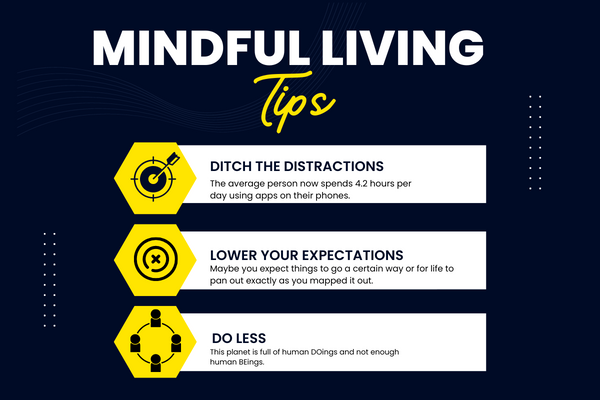
In today’s world, we value busyness above all else. If we’re not doing something or going somewhere, we must be wasting valuable time, right? This planet is full of human DOings and not enough human BEings.
If you want to live more mindfully, declutter your mind and live a healthy lifestyle, do less. It’s okay to say “no.” It’s okay to do nothing. Give yourself permission to just be in the moment without judgment or expectations.
When you have less on your plate, you have more time for being in the present moment.
2. Lower Your Expectations
If you’re like most people, you probably make plans and set goals. Maybe you expect things to go a certain way or for life to pan out exactly as you mapped it out.
Let’s say that you’re planning a trip to Europe. You have hopes and expectations of seeing all of these beautiful things and meeting new people. But during your trip, you encounter bad weather, your partner gets sick, and you wind up spending half the trip stuck in a hotel room. Your high expectations leave you feeling disappointed and angry. This was supposed to be the trip of a lifetime.
Expecting what life cannot give us is a surefire way to be disappointed. To live more mindfully, lower your expectations. Better yet, throw them out of the window. Because when you have an idea of how things should go, you’re only living in the future instead of living in the moment.
When you have no expectations, life becomes an adventure. You never know what’s around the corner, and you adapt to change without missing a beat.
3. Ditch the Distractions
The average person now spends 4.2 hoursper day using apps on their phones. That’s up 30% from 2019. In some parts of the world, people spend an average of 5 hours a day on their phones. This doesn’t include the amount of time people spend streaming TV and movies or watching television.
We are living in a world of distractions and information overload. It can be challenging to stay rooted in reality and the present moment when distractions are just a tap away.
To live mindfully, ditch the distractions. I’m not asking you to throw your phone out the window or cancel your Netflix subscription (although you can if you want!). But be mindful of the time you’re spending on these things.
Put away your phone when you’re eating with your family. Instead of spending hours playing games on your phone, give yourself 20-30 minutes. Be with the people you love.
Limiting your screen time and eliminating as many distractions as possible will help you be mindful of every moment. Because you can’t be present if you’re constantly trying to escape reality.
4. Connect to Your Senses
Your body is equipped with five incredible senses. Use them to ground you in the present and be aware of each moment. After all, the practice of mindfulness is all about being aware of all the sensations, smells, sounds, tastes and sights in the world around you.
How can you connect with your senses? Do a body scan.
Pay attention to your breathing (a.k.a. mindful breathing). Feel the ebb and flow of each breath. Notice any feelings that come through. Be aware of the sound of your breath. Conscious breathing is a powerful mindfulness practice.
Observe the world around you. What do you see?
Listen closely to the sounds around you. What do you hear?
What do you smell or taste?
Going through each individual sense can help you really become fully immersed in the moment. Make this a part of your regular practice to pull yourself into the present when you’re feeling distracted or moving on autopilot.
5. Accept and Observe Discomfort
The mindful life is all about being aware of and observing the present moment, and that includes negative emotions. As much as we would like to believe that life is rainbows and butterflies, it’s not. It can be hard to accept discomfort because our natural reaction is to find a way to escape it.
But life is not always easy or even enjoyable. It can be tough – grueling even. We grieve. We hurt. We get sick. Our loved ones pass on and leave us behind. Instead of running away from discomfort, pain or emotion, accept it. Observe it. In fact, open the door and welcome those difficult emotions. Acknowledge them, and then let them go.
The mindfulness practice, or meditation in general, you learn how to put space between yourself and your negative emotions and thoughts. You accept and observe discomfort without attachment or judgment.
The next time you feel sad, angry or anxious, pause for a moment and just allow your emotions to roll over you like a wave. It takes time, practice and patience to the art of mindful living, so be kind and patient with yourself as you learn how to accept discomfort.
6. Practice Gratitude
When you practice gratitude, you become mindful of all the wonderful things in your life. So, before you go to bed tonight, take a moment to identify three things you’re grateful for. You can write these things down in a journal if you like, but that’s not necessary. Just reflect on the day and express your appreciation in life. Make gratitude a daily habit.
In addition to helping you live more mindfully, gratitude can also help:
Gratitude is a powerful thing, and it helps you become keenly aware of your blessings, which can have positive effects on your mental health.
7. Shake Things Up
If you want to learn how to become mindful, shake up your usual routine.
Take a new route home
Try a new restaurant
Strike up a conversation with a stranger
Breaking patterns and getting out of your usual routine anchors you to the present moment. Because when you’re just going through the motions and doing the same thing day in and day out, you’re living on autopilot. Tiptoe out of your comfort zone and notice how something as small and simple as changing your route home from work can bring you to the present moment.
Why does this happen? Because when you’re doing something new, you don’t know what to expect. When you venture into the unknown, you must be alert and aware of the world around you so that you can act accordingly.
Mindful Living is an Art and Science
Although it’s difficult to master the art of mindful living, it’s well worth the effort. Because when you do, you find beauty, contentment and peace of mind regardless of what’s going on around you. Use these mindful living tips to start living in the present.
Mindfulness is all the rage today, but this practice has ancient roots. Thanks to modern research, science has managed to demystify mindfulness and meditation. But how exactly do you practice it?
If you’re new to the idea of mindfulness, you may be wondering what it is, its benefits and how to get started with it.
What is Mindfulness?
Mindfulness is a concept that’s hard to define because it comes in so many different forms. Even something as simple as washing the dishes can be transformed into a mindfulness practice.
At its heart, mindfulness is about being calmly aware of the present moment without judgment.
Simply put, you are keenly aware of where you are and what you are doing, but you’re not reacting or judging the moment. Imagine a chaotic street and one person sitting calmly and peacefully at the center of it all. That’s the idea of mindfulness. No matter what is happening at any given moment, we are aware of it, but we are not reacting to it.
Everyone – no matter your age or where you come from – can practice mindfulness. But in today’s modern world, where we are constantly bombarded with information and distraction, it can be challenging to tap into this innate ability.
Fortunately, you can use several techniques and exercises to practice mindfulness and help you enter this state of mind (more on that soon).
What is the History of Mindfulness?
Mindfulness is a practice that dates back thousands of years. The exact origin of the practice is unknown, but it’s a concept with roots in Eastern religious and secular traditions, including Buddhism, Hinduism and yoga. Scholars also argue that the idea of mindfulness also has roots in Islam, Judaism and Christianity.
Still, practitioners and teachers today generally learned about mindfulness in either the Hindu or Buddhist tradition.
Jon Kabat-Zinn is credited with bringing the concept of mindfulness from the East to the West. He founded the Center for Mindfulness, which is located at the University of Massachusetts Medical School. He is also the creator of the Mindfulness-Based Stress Reduction, or MBSR, eight-week program.
Kabat-Zinn studied mindfulness under Buddhist teachers, including the well-known Thich Nhat Hanh. Then, he integrated the idea of mindfulness into Western science to create his program.
How Does Mindfulness Make You Feel?
Because mindfulness is a personal practice, it’s difficult to describe how it feels. You may feel a whirlwind of emotions during your session, but if you’re succeeding with your practice, those emotions will come and go like clouds floating through the sky.
When you are purposely making yourself aware of your surroundings, you may experience:
Sensations in the body. For example, if you are anxious, you may notice a tightening in your chest or your quick heartbeat.
Sights. You may notice every little detail in the world around you.
Emotions. If you have pent-up feelings, like anger or sadness, these may come through and in an intense way. For many, mindfulness acts as a release for these emotions. Others feel intense euphoria or joy.
Thoughts. We all have an endless supply of thoughts running through our minds 24/7, but how many do you pay attention to? Mindfulness can make you keenly aware of your thoughts and just how intrusive they can be.
Many people associate mindfulness with joy and happiness. Perhaps that’s because when you are practicing, you are living moment to moment. You stop that vicious cycle of being stuck in the past or drowning in painful emotions. For just a moment in time, you get out of your own head.
But getting to that point of joy and happiness isn’t always easy. Many newbies say that practicing mindfulness makes them uncomfortable, but that’s a sign that it’s working. Why? Because when we’re truly mindful, we’re hyper-aware of all of our emotions, and that includes the not-so-pleasant ones, like:
Anger
Sadness
Jealousy
Loneliness
Fear
The goal is to be aware of these emotions but not to give into them. You experience them without becoming overwhelmed by them. As you become less reactive to these emotions through your mindfulness practice, you can make better decisions and handle day-to-day situations with a clear mind.
What are the Benefits of Mindfulness?
One thing that sets mindfulness apart from some other stress-reduction techniques is that it’s backed by science. The practice has been heavily studied, and it continues to be studied today.
Research has found that mindfulness can be beneficial for both your physical and mental health.
Mindfulness may help:
Reduce Stress
Several studies support the claim that mindfulness can reduce stress. For example, in one study, injured athletes who practiced mindfulness meditation saw decreased anxiety and stress. The mindfulness group also saw an increase in pain tolerance.
Reducing stress can go a long way in helping you stay healthy and happy.
Ease Anxiety and Depression
Mindfulness is often used to help with anxiety and depression. One meta-analysis involving 47 studies found that mindfulness meditation programs effectively reduced the adverse effects of stress. The results were comparable to antidepressants.
Promote Immune Health
Most people associate mindfulness with mental health, but it may also help with your physical health – including your immune health.
One review looked at 20 random clinical trials with over 1,600 participants. Researchers found that mindfulness meditation may help:
Reduce pro-inflammatory responses
Increase enzyme activity that helps protect against cell aging
More research is needed to better understand mindfulness’ effects on the immune system, but the results so far have been promising.
The theory is that the practice of mindfulness can help reduce stress, which can ultimately help prevent the immune system from becoming run down. Chronic stress can lead to inflammation that may hinder your immune response.
Change Your Brain
Practicing mindfulness meditation can literally change your brain – and for the better. One study took a look at MRI scans of people who practiced meditation for an eight-week course. The results showed that the area of the brain associated with “fight or flight,” the amygdala, shrank. The pre-frontal cortex, which is linked to concentration, awareness and decision-making, became thicker.
Not only do these areas change, but the way in which they connect also changes. The results showed that the connection between the amygdala and other areas of the brain became weaker. The connection between the pre-frontal cortex and the rest of the brain got stronger.
Mindfulness meditation can change the brain in other ways. For example, researchers have found that the practice can make you less aversive to stimuli, including pain.
A fascinating find was that the brain only changes for a period of time. Once you become an expert in mindfulness meditation, these areas of the brain start to normalize again. Researchers found that brain scans of expert meditators who weren’t meditating were similar to those who were meditating. In other words, the meditative state becomes the default state.
How to Practice Mindfulness
The benefits of mindfulness are impressive, but how do you practice it? If you’re wondering, “How can I stay mindful all day?” we’re going to share some tips to help you get started.
Mindfulness Techniques
The reason why so many people struggle with mindfulness, and meditation in general, is because there’s really no solid blueprint for success. If you’re baking a cake, you follow a recipe and wind up with exactly what you expect – a cake.
The mindfulness state of mind is difficult to describe, so how do you know when you’ve arrived? That’s what makes this a tricky practice.
Fortunately, there are many mindfulness exercises you can use to help you master this practice.
Eating Mindfully
One simple way to practice mindfulness is when you eat. It’s something we all do every single day, so this allows you to be mindful at least once per day.
Try this:
Focus on your breathing. Close your eyes, and breathe slowly in and out of your belly. Take 10 deep breaths before starting your meal.
Continue breathing deeply and begin eating. Take it slow, and take deep breaths as you continue eating.
Relax your body. It is much easier to digest and absorb the food you eat when your body is in a relaxed state.
Take each bite mindfully. Focus on the textures and flavors you’re experiencing. Feel the joy with each bite.
By focusing your attention on the experience of taking each bite, you can start building your mindfulness skills.
Practice STOP
It’s a fitting name for this practice.
Stand up on your feet. Breathe. Feel the ground beneath your feet and your connection to the earth.
Tune in. Bring your attention to the physical sensations in your body. Exhale any unpleasant sensations or thoughts. Inhale joy and let it fill you with each breath.
Observe the world around you. Find something in the room or outdoors that is pleasing or beautiful.
Possibility. Think about possibility and how you can take the next step forward.
Taking the time to stop and focus your awareness on your surroundings can help you get into a mindful state.
Body Scan
The body scan exercise is a simple way to practice mindfulness, and it’s one of the more accessible ways for beginners to get initiated with the practice.
Try this:
Start by laying down on your back with your palms facing up and your feet apart. If you’re unable to lay down, you can do this while sitting comfortably in a chair with your feet resting on the floor.
Try to limit your movement during this practice.
Bring your attention to your breath, its rhythm and the sensation of inhaling and exhaling. Do not change the way you breathe, but rather, just bring a gentle awareness to your natural breath.
Now, bring your awareness to your body. Notice how your clothing feels against your skin, the temperature of your body and the environment surrounding you.
Next, focus on the areas of the body that are feeling light, heavy, tingly or sore. Make a note of any areas where you may feel overly stimulated or have no sensation at all.
Now, start focusing on each part of your body one at a time – from your head to your toes. Notice sensations or lack of feeling in each area.
Once you have gone through each area of the body, you can open your eyes and start to shift your position slowly.
Ensure that you choose a quiet place for this exercise where you won’t be disturbed by others.
The Five Senses Technique
The Five Senses exercise is a great way to use mindfulness anytime, anywhere. It’s something you can do quickly and without anyone knowing what you’re doing. The goal is to experience something with all of your senses.
Find five things you can see. Look around. Find five things you can see. These should be things that you wouldn’t normally pay attention to, like a crack in the sidewalk.
Find four things you feel. Bring your awareness to four things you’re feeling in this moment, like the wind in your hair or the texture of your clothing.
Find three things that you can hear. Listen for a moment. Find three things that you can hear, whether it’s the chirping of birds or the quiet hum of the fan.
Find two things you can smell. Turn your attention to the scents around you, and pick out two that you notice.
Find one thing that you can taste. What is one thing that you can taste right now? It may just be the taste of your mouth, or you can take a deep breath to taste the air.
The Five Senses exercise is a simple way to bring awareness to the present moment and really experience everything with all of your senses.
Mindful Breathing
The techniques above are great ways to get started with mindfulness. And if you notice, many of them aim to bring your attention to your breath.
Focusing on the breath is one of the simplest and most effective ways to practice mindfulness. Take 15 minutes out of your day to follow this practice.
Mindful breathing is so simple:
Focus your attention on each inhale and exhale.
You can practice mindful breathing while sitting, lying or standing. Your eyes can be open or closed – it’s up to you.
While you can practice this breathing exercise anytime you want, it can help to use it when you’re experiencing stress. If it’s a particularly stressful situation, you can take an exaggerated first breath to bring your mind to a state of calmness.
Take a long, deep breath through your nose.
Hold it at the top of the inhale for two seconds.
Take a long exhale through the mouth.
Focusing on your breath and being aware of your surroundings will help put you in a meditative state and trigger your body’s relaxation response.
With daily practice, you may find that your emotional responses and stress responses start to improve.
Walking Meditation
Like the body scan exercise, walking meditation is another accessible, simple way to practice mindfulness. All it takes is 10 minutes a day.
You can practice walking meditation anywhere, but we recommend finding a peaceful park or a walking trail if the weather permits. Being out in nature will make it easier to direct your attention to the present moment.
Start by walking 10-15 steps forward.
Pause for as long as you like and take a deep breath.
Turn around, and begin walking in the opposite direction.
Repeat the pause and keep taking deep breaths.
As you take each step, think deliberately about each action: lifting your foot, moving the foot forward, placing the foot on the floor, shifting forward and moving the weight from the back to the front of your foot. You can also bring your attention to other sensations, sounds and smells.
Walk slowly. You can keep your hands clasped behind or in front of you.
If you notice your mind wandering, don’t worry – that’s normal. Each time you become aware of the wandering, redirect your focus back to your walking exercise.
Try to incorporate walking meditation into your daily routine, and you’ll notice yourself becoming more mindful with each passing day.
Mindfulness Meditation
Of course, mindfulness meditation is one of the best ways to practice mindfulness. All of the exercises and techniques we’ve covered so far are, essentially, a form of meditation.
The goal is simple:
Sit peacefully.
Focus on your breath.
Bring your attention to the present moment.
If you’re having difficulty sitting calmly and allowing your thoughts to just float on, then try a guided meditation. Here are some recommended practices to try.
Mindfulness Journal
If you’re looking for a more structured way to incorporate mindfulness into your life, a journal may help. There are many mindfulness journals out there, and they aim to help change the way you think and observe the world around you.
The Mindful Journal asks you to take just seven minutes a day to be mindful and grateful for the things in your life. This journal includes three months of non-dated pages for entries. You’re asked to write down two things that you’re grateful for each morning and evening.
Each day, you’re given eight feeling words to choose from, and you can incorporate them into your entries however you see fit.
It also includes almost 100 quotes, 13 different mindfulness exercises and blank pages so that you can write down whatever you want.
Mindfulness Books
Journals are a great way to take an interactive approach to mindfulness, but books can also be beneficial. Books can better explain the concepts behind mindfulness and give you some deeper insight into the practice. Many will also include exercises and techniques to help you on your mindfulness journey.
There are so many ways to practice mindfulness. If you’re struggling to get into that state of present-moment awareness, there is always a new method to try. Use the tips above to get started on your mindfulness journey today.