Cheat exercises are something that not many people are talking about in the fitness world. AND, we do mean “cheat exercises” and not chest exercises, which was the only thing I could really find when trying to research this topic at first.
Warning Before Doing Any Cheat Exercises
Form is essential when exercising because you can hurt yourself if you compensate with other muscles, too much. If you’re planning to perform cheat exercises, please be careful and know that we’re not responsible if you hurt yourself.
What are Cheat Exercises?
Cheat exercises are when you perform any type of exercise without perfect form to try and push past your own limits. You might use momentum to your advantage on cheat reps, and you’re going to get a lot of hate on Instagram and social media for it.
You’ll see a lot of unfit people telling the world’s strongest people:
Hey, you’re doing that wrong.
Terrible form bro.
Etc.
Form is important, and you don’t want to use cheat reps all the time, but they can be an important tool in your arsenal to promote muscle growth and strength gains.
Extended Set Cheats AKA Cheat Reps
Cheat reps work something like this:
Perform the set with good form
Keep pushing the set beyond your limit (when form gets bad)
Push past your normal point of failure using momentum or by engaging other muscle groups
Performing strict bicep curls is a prime example of a time when you might use cheat sets. You’ll perform, let’s say 8 reps at whatever rep range and you’ve been stuck in a plateau for quite a while.
After a few weeks of struggling to break through the plateau, you decide to use cheat exercises. When you hit rep 8 and can’t perform another rep, you use momentum on the last repetition to bust out another rep or two or three.
You’re fatiguing the muscle further, and when the muscle fibers heal, they’ll be stronger.
Still not understanding?
Let’s assume that you’re performing seated rows. You’re doing amazing, your back is on fire and you feel like that’s It, you can’t perform another rep in isolation. You might start engaging your biceps more and breaking out of isolation to engage more muscles and get the extra rep or two in for the exercise.
That’s a cheat rep.
However, there is also another type of cheat exercise to know about.
Cheat Exercises with Heavier Weight AKA “Heavy Cheat”
Lifting heavy builds more muscle, and if that’s your goal, you need to push your limits in the gym. You can perform cheat exercises with heavy weight, but you need to be very careful and do them at your own discretion because you can hurt yourself in the process.
The idea is simple:
Form is less strict
Multiple accessory muscles are engaged
You perform one or two reps
However, if you’re lifting heavy and beyond your normal capacity, this is often a discouraged training method due to the high risk of injury. In addition, anyone who has had injuries will want to avoid cheat exercises with heavy weight.
A prime example of cheating with heavy weight is doing a deadlift.
People that are cheating will jerk their back and force the weight up. Unfortunately, this is also a great way to destroy your back and be in pain for the rest of your life.
Why Cheating Get a Bad Name?
So, cheat exercises can be good and bad, but why do they have a bad name? Well, the main reason is that cheating like this is often done by beginners trying to look good in the gym and leads to injury.
You can cheat on some exercises more safely than others, and keep this in mind when trying this method.
Never Try Cheat Exercises for:
Barbell bench press
Barbell rows
Calf raises
Chest flys
Deadlifts
Leg curls
Shrugs
Squats
Upfront rows
Dips
Preacher curls
Skull crusher
Chin-up
If you do cheat exercises with these and a few others, you’re really risking serious injury, especially in your back, which can lead to months out of the gym and years of pain.
Exercises Where Cheating is Less Risky
Dumbbell curls
EZ-bar curls
Lat raises
Lat pulldown (NOT behind the neck)
Seated leg press
Tricep pushdown
Also, if you plan on going into any competitions or to break records, the judges will disqualify you for cheating.
Tips When Performing These Exercises
If you’re doing cheat reps or heavy cheats, be sure to follow a few tips below:
DO NOT mess around with your lumbar spine. If your spinal position is compromised at all, you risk hurting your back, which absolutely will set you back.
PREPARE for the eccentric part of the movement, because you will need to control the weight you lift.
FINISH with a cheat rather than start with it. 99% of what you do during your session should be with perfect form and muscle isolation. Just if you’re going to perform cheats, be sure that they’re the finisher for the muscle group you’re working.
How Often Should You Do Cheat Exercises?
What most people recommend is that you try making your gains the natural way. Perform your sets using strict form, add weight over time and break those plateaus.
However, it’s not recommended to:
Perform cheat sets for more than 1 – 2 sets per body part
Perform heavy cheats for more than 1 – 2 sets per body part
It’s often better to incorporate other tweaks to your workout to try and find ways to reach your goals without trying to cheat. The risk of injury is high, and if you’re trying to cheat on the wrong exercise, you can cause some serious damage to your body.
“Dumb cheating” gets you hurt, and “smart cheating” may help you add on a little more muscle and boost your strength if you’ve hit a sticking point and haven’t been able to bump the weight up in months.
Cheat exercises and reps will help you overload your muscles, breaking out of your typical isolation reps and allowing other muscles to assist on the rep.
If you’re just starting on a weight loss or muscle building journey, you want to focus on getting to the gym and working out regularly rather than worrying about:
Strength workouts
Power workouts
Endurance workouts
Each type of workout is essential, but you should focus on a standard routine before diving into the logistics of strength, power and endurance. All three types of exercises are necessary for “whole-body health,” but you’ll find many people focus on one or two types of workouts.
Why?
Everyone has their own goals.
If you want to build muscle, a power or strength training workout is likely what you’ll focus on. But if you want to maintain your strength over lengthy activities, an endurance workout planmay be a better choice.
Let’s look at all three workout types, how to perform them and which you should be doing.
What is a Strength Workout?
When performing a strength training workout, you’re trying to move as much weight as possible for a specific amount of reps. A powerlifting workout is all about strength training. For example, you might train at your 1 rep max (RM) to increase your deadlift.
In short, strength training focuses on the force needed to overcome resistance.
How To Workout for Strength?
A strength training routine can be adjusted to meet your goals. If you want to build strength, you certainly can with a 10 rep routine, but when you’re trying to add mass and increase your one-rep max, your routine may be:
5 repetitions for 5 sets
3 repetitions for 3 sets
1 repetition for 3 / 5 sets
When trying to build strength, the key most important thing is to find your 1 repetition maximum. For example, if you can bench 200 pounds for one rep, this is your maximum. Finding this number is crucial because you’ll use it to develop your routine.
You might perform your 5 x 5 routine at 80% RM, your 3 x 3 routine at 90 RM and then your 1 RM should be as heavy as you can go.
High load resistance led to an increase in maximum strength of 6.5%
Low load resistance led to an increase in maximum strength of 2%
Remember that muscle endurance didn’t increase for the high load group as it did for the low load group, but we’ll cover this in greater detail below.
Strength training exercises should focus on major muscle groups. A strength program should include a mix of activities, but compound exercises provide the most muscle engagement. You’ll burn more body fat and add more lean muscle mass by including major muscle groups into your training plan.
How Long Should a Strength Training Workout Be?
Your routine length depends on how many exercises you’re performing. For example, if you’re a beginner, you may want to perform three strength exercises per strength session, while someone advanced may be doing five or six exercises each workout.
But you’ll spend most of your workout session resting. Building strength demands high energy expenditure, so to maximum benefits and reach fitness goals, slot in rest periods in your fitness routine.
Most experts suggest resting for 2 to 3 minutes between strength training sets. If you’re doing a 5 x 5 routine, this means you’ll spend 10 – 15 minutes resting per exercise.
Many people can’t dedicate hours a day to exercise, so a good 45 to 60-minute workout will suffice.
Due to the heavy weight involved in this type of strength training, you’re at a higher risk of injury. Try to maintain perfect form to minimize injury risk.
But if you want to know how many weeks you should be training for strength, an 8 to 12 weeks is great before switching up to power or endurance for a few weeks. You want to keep your muscles growing, and growth means keeping your muscles guessing.
Note: A study on rest between sets, using two to five-minute rest periods, did not find a difference in neuromuscular and hormonal response. If you only need two minutes, don’t prolong the rest period because it won’t benefit you.
How Long Does Muscle Synthesis Continue After a Strength Training Workout?
A 1995 study on muscle protein synthesis found the following:
Synthesis remained more than double normal synthesis rates 24 hours after heavy resistance exercise
Synthesis rapidly declined to near baseline 36 hours after a workout
The synthesis process pushes your proteins 50% higher in the first four hours after your workout ends and 109% higher after 24 hours.
Quick note
It’s essential to warm up before a workout if you’re focusing on strength or power because you’ll use a heavier weight. If you want to exercise for strength or power, be sure to warm up to avoid muscle injuries and strains.
What is a Power Workout?
Power is vital, although a little bit confusing to understand. This is because so many people, myself included at one point, thought that power and strength were the same. But they’re slightly different.
When you focus on power, you’re focusing on overcoming resistance in the shortest amount of time possible.
For sports athletes, power is necessary because it uses:
Force
Velocity
When you need to engage in high-speed movements, a power workout will make these rapid movements.
Interestingly, studies on power workouts have shown very positive results for older adults, although studies also show that power training is more effective than traditional training. A study from 2005 shows that a progressive resistance training routine can help older adults in numerous ways:
Offer rapid strength gain
Increase in power
Enhance physical performance
Focusing on power can make standing up from chairs or off the floor easier for older adults and younger ones. But, of course, power training is being combined with strength training in a clinical setting to maximize benefits.
Increased reaction time, cardiovascular endurance and even better coordination and balance are associated with power training.
How can you adapt your workout routine to include explosive power?
How To Workout for Power?
Remember, it’s essential to do two main things for power: train for strength and speed. You’ll be working on your fast-twitch muscle fibers when you’re engaging in a power routine, and this often leads to three main types of exercises performed:
Plyometric. High-intensity and often called “shock training,” plyometrics involve jumping or hopping. You might see athletes jumping side to side to improve their explosiveness with these movements. Broad jumps or adding in a box jump would be included.
Ballistic. Movements in a ballistic training routine may include throwing a medicine ball overhead and includes releasing weight.
Dynamic. A form most people engage in which requires lifting light weights in the 50% to 60% 1RM range as quickly as possible for 4 to 5 reps. Olympic lifts are a good option here.
Maintaining proper form and resting between sets are essential when engaging in a dynamic workout. Rest will often be between 3 and 4 minutes, but it can be more if necessary.
You can use free weights, kettlebells, bodyweight, resistance bands, resistance tubing and even medicine balls in a dynamic workout.
Explosive power exercises can focus on the upper body or lower body. In addition, power moves often include compound exercises to maximize athletic performance and strength. Deadlifts, a vertical jump, depth jump or a power clean are all examples of exercises to add to your power training.
If you’re training for power, you should focus on the following:
Weight ranges of 0% to 70% of your 1RM
Repetitions between 2 and 6
Speed is integral in your routine, so you may want to time yourself for a specific duration. For example, let’s assume that you’re training with 20-second sets. Naturally, you’ll want to squeeze as many reps into this time as possible, even if that means you hit 10 reps.
Ideally, you’ll reach 4 to 6 reps in this timeframe.
Depending on the exercise chosen, you may want to perform 2 to 3 sets of each exercise. If you find that you’re hitting 7 or 8 reps fast, increase the weight.
How Long Should a Power Workout Be?
Power workouts are similar to strength in that you’ll want to train for 45 to 60 minutes at a time. However, due to the stress on the nervous system, it’s recommended that you perform 2 to 3 power workouts maximum per week.
Your nervous system needs two to three days to repair.
What is an Endurance Workout?
If there’s any form of exercise that affects the brain, it’s an endurance workout routine. You’ll push your limits – I hope – by creating an endurance workout that leaves your muscles on fire at the end of your session.
In terms of mental torture, these routines are intense.
You’ll perform high rep ranges, use light weights, and rest for 30 seconds to a minute between each set. Muscular endurance allows you to perform movements or tasks for long periods without getting as tired.
If you need to lift 40-pound bags of rocks for an hour, endurance training will help you become more efficient than strength training.
Endurance activities should be added to training sessions. However, heavy weight training shouldn’t be the only form of exercise that you perform. Building a training program that incorporates light weight and basic endurance exercise is crucial for functional training.
How To Workout for Endurance?
What exercises are endurance workouts? They’re not aerobic exercise nor are they cardio exercise, although they can get your heart rate soaring.
Endurance workouts are high-intensity workouts that focus on lighter weight and more repetitions. Building muscular endurance requires repetitions in the 12 to 20+. Personally, I like to perform at least 12 to 15 reps, but I’ll continue my repetitions until my form breaks down or I can no longer lift the weight.
Sometimes, I’ll hit 30+ reps, and other times I’ll hit 21 – every time, I’m going as hard as I can.
You’ll want to perform 3 or 4 sets of each exercise you perform. Examples of endurance exercises for a back routine:
4 sets of 15 to 30 reps of rows
4 sets of 15 to 30 reps of lat pulldowns
4 sets of 15 to 30 reps of deadlifts
Of course, you can add in more exercises if you want to build an endurance workout that works on your weaknesses and goals.
How Long Should an Endurance Workout Be?
Speed is the name of the game with endurance workouts. How many sets are in an endurance workout? It depends on your rest period, repetitions, sets and number of exercises. Let’s assume the following:
3 exercises chosen
4 sets each exercise
15 reps per set
Let’s assume it takes 1 second up and 3 seconds down for each repetition and 30 to 60 seconds of rest. This would mean completing every set would take around 1 minute for 15 reps plus an additional 30 to 60 seconds of resting.
Each exercise may take up to 8 minutes to complete all four sets of a single exercise.
You’ll also need to switch machines or weights, and you’ll easily be in the 30-to-40-minute range or higher if you add in more exercises. Endurance activity should be performed in a short period of time to minimize rest.
Try to perform your reps as fast as possible and completely forget about your traditional workout speed. Your speed and minimal rest make every session a challenging workout. Minute rest periods are great because minute recovery allows you to rest just long enough to go on to your next set.
Endurance workouts should start with beginner exercises and advance as your skill levels improve.
How Long Does Muscle Synthesis Continue After an Endurance Training Workout?
Endurance training also produces a different protein and adaptive response than strength training, according to a 2018 study. In addition, the study found that both regular and irregular bouts of endurance training led to higher levels of:
But while the body needs more protein after an endurance workout, there’s little information on if muscle synthesis improves significantly.
Strength vs. Power vs. Endurance Workout: Which Should You Do?
All of them. We all have our goals, and if you’re a powerlifter, you know that strength will be your primary focus. You want to make sure that you can push or pull through as much resistance as possible. But then you have people like Julius Maddox (IrregularStrength) trying to break the world record for bench press.
Maddox holds the world record for bench press at 782, but he’s pushing to reach 800 pounds.
You’ll see him doing 700+ pounds for 1 or 2 reps and then 661 pounds for 5 sets. He focuses on power and strength.
But for well-rounded fitness, you should mix in strength, power and endurance training. You can make up your own routine of periodization where maybe you do 4 weeks of strength training followed by a week or two of endurance training.
Some routines are also changed weekly, for example:
Week 1 strength
Week 2 endurance
Week 3 power
Week 4 hypertrophy (8 to 12 reps)
If you want the best general health possible, you need to mix strength workouts, power workouts and endurance workouts into your routine. You can also slot in certain workout types on certain days.
Let’s assume that on Monday, you’re dead. You’re not able to push 80% of the weight you did Friday, and it’s just an off day. Perform an endurance workout to mix things up.
You want to keep your body guessing to stop plateaus from occurring. However, even an elite athlete needs to change their training sessions up.
There are also athletes and fitness experts following what is known as undulating periodization. What does undulating periodization mean? It’s a type of workout schedule that changes from one day to the next.
It’s all about flexibility with this type of periodization.
Monday, you’re feeling weak, boom do an endurance workout. Tuesday, do a hypertrophy workout and Wednesday, focus on your strength and power workout routines. You need to hold yourself accountable so that you’re not always doing a hypertrophy or endurance workout, and if you do, you’ll reap the rewards.
Since you’re keeping your body guessing from one day to the next, you’ll develop more strength faster, according to a 2002study. The study found, over four weeks, participants that altered their training every day experienced more strength gain than those who didn’t.
If you’re trying to decide whether you want to focus on strength, power, endurance or hypertrophy, add them all into the mix for the best results.
Exercise and the brain: what’s the correlation? I know when I exercise, it’s a major stress relief. And when talking to people at my local gym, everyone seems to agree that exercise is a better way to release stress than even marijuana.
But why?
Exercise Boosts Dopamine and Serotonin
Depression is an epidemic, and chances are you know someone with depression. Everyone gets depressed once in a while – life is difficult and unpredictable.
The World Health Organization (WHO) claims that 300 million people worldwide suffer from depression. You’re not alone if you’re depressed. I know there are some days, for no apparent reason, I just wish I didn’t wake up in the morning.
My theory has always been that lack of moving plays a role in depression.
A lot of people don’t feel like they have a purpose. A lot of people are also stuck behind a desk all day, and it’s easier to pull up to a drive-thru than it is to get out of the car and sit down for dinner after a long day of work.
Yet regular exercise tends to relieve many people from the depression that they’re suffering from.
Why?
Research has shown that physical activity, whether it be yoga, weight training or even a brisk walk around the block, helps the brain produce:
Dopamine
Serotonin
Both of these brain chemicals are responsible for keeping you happy. Endorphins, the feel-good chemicals produced by the brain, are also produced.
Anxiety and depression can be helped with a bit of exercise.
Exercise and the brain are intrinsically tied based on these facts. If you want to improve brain health, start with a regular exercise routine.
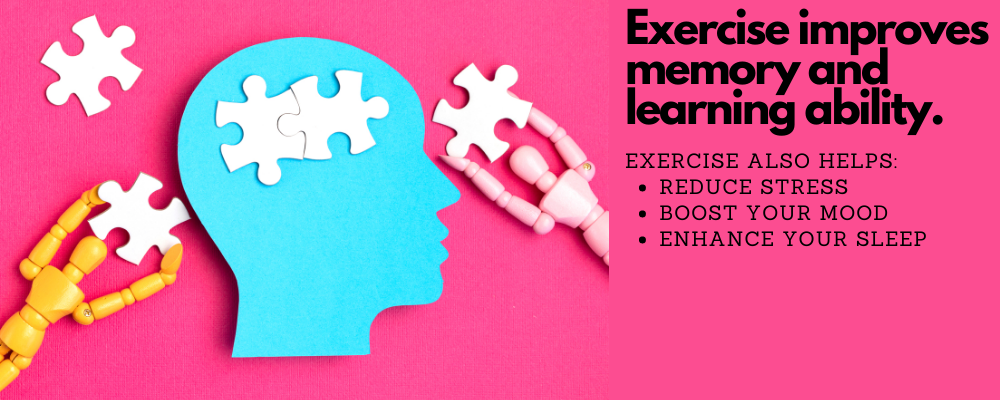
Exercise Improves Memory and Learning Ability
Studies, one in particular from the University of British Columbia, found that aerobic exercise is able to enhance the hippocampus.
But why does this matter?
The hippocampus is the area of the brain that is responsible for:
Verbal memory
Learning
One thing to note is that researchers only experienced these results with aerobic exercise. Participants in the study that did the following did not have the same results:
Muscle toning exercises
Balance training
Resistance training
I guess all those times that I have weight trained and walked by the cardio machines on the way out of the gym are now a big regret. Plus, it’s important to focus on your cardiovascular health, too.
The effects of exercise was shown to help direct and indirect memory and thinking ability.
Your brain suffers from inflammation and a lot is going on all at once. Insulin levels are fluctuating, hormones and chemicals are being produced.
Exercise directly impacts the brain by:
Stimulating new blood vessel growth
Reducing inflammation in the brain
Reducing insulin resistance
These are all direct benefits to the brain, but there are also indirect positive effects that are experienced. The benefits of exercise also:
Reduce stress
Boost your mood
Enhance your sleep
When you sleep, the brain has time to rid itself of toxins and start repairing the body. Stress, mood and sleep play an integral role in your cognition. If you have problems in any of these three areas, they will contribute to cognitive impairment.
Dr. Scott McGinnis of Harvard Medical School, claims that many studies found that the prefrontal cortex has a larger volume in people that exercise. The prefrontal cortex is responsible for memory and your ability to think.
I figured, after reading this study, that it would take years for any part of my brain to actually change.
I was wrong.
Moderate exercise, over a six-month period or year, can increase the volume of select areas of the brain. Cognitive abilities improve, and the benefits of exercise seem rapid.
Participants in the study walked for 120 minutes a week – that’s it. Will HIIT and other aerobic exercises produce the same results? Chances are that they will.
Update: New Study Links Irisin and Cognitive Function Together
Since first publishing this article, there has been a very interesting study done on exercise and the brain. The study was conducted b Nature Metabolism in 2021. The study was done on mice and found that following exercise, there was a notable increase in the irisin hormone.
Irisin was found to enter the brain post-exercise and improve cognition.
Additionally, the hormone is also known as an anti-inflammatory and protects against neuroinflammation.
Exercise and the Brain: Does Exercise Heal the Brain?
If you have severe brain damage, your memory function and cognitive abilities may be impaired. “Healing” may be promoted with physical exercise, but you’re not likely to reduce any extensive brain damage.
But the brain will benefit from an increase in blood flow and reduction in oxidative stress.
Researchers have studied the positive benefits of exercise on the recovery of traumatic brain injury (TBI). A 2012 study found that aerobic exercise was able to help relieve depression among TBI sufferers. The study included:
Participants that were injured 11 months or longer prior to the study
12-week of aerobic exercise program
After the human studies, all participants suffered from lower levels of depression, noted higher self-esteem and also improved their aerobic capacity. No adverse side effects were reported.
But what about someone that has a TBI or a serious concussion? Can the brain heal from exercise? The truth is that there’s simply not enough studies to rely on that are not bias or seriously lacking. Further studies need to be conducted to see if there’s a link between exercise and healing improvements for TBIs or concussions.
What About Resistance Training? It Must Do Something!
I hate cardio. I would much rather do resistance training, but for the betterment of my brain, I will start doing more aerobic exercise after writing this article.
Thankfully, exercise and the brain can also include resistance training. resistance training has been shown to also benefit the brain.
Executive memory and function are very important, but a lot of people have no idea what this means. Executive function allows you to:
Plan for the future
Perform complex tasks
Organize information
Think in an abstract manner
Store working memory
Studies show that in people aged 55 or older, exercise increases the person’s ability to perform well on cognitive tests by 400%. Substantial benefits were exhibited in as little as four weeks with exercise sessions lasting 30 – 45 minutes.
Interestingly, one study also found that taking steps when walking send waves through the body into the arteries. When this happens, blood flow increases to the brain. Increased blood flow into the brain results in more nutrients and oxygen to the brain.
Enhanced blood flow to the brain can also create new blood cells and there’s also the brain-derived neurotrophic factor (BDNF), which helps protect and repair brain cells from degeneration.
Exercise and the effects on brain health show a direct correlation to improved cognitive skills, lower stress hormones and a plethora of mental health benefits.
Getting Started With Exercise If You Have Mental Health Issues
If you’re depressed, anxious or suffering from mental health issues, it can be hard to even think about exercising. People that don’t have any mental health concerns struggle to get out of bed or off the couch and exercise.
A lot of people, myself included, always find ways to be “too busy” to exercise when in reality I could fit in a 30 – 40+ minute workout every day.
If you find yourself struggling to get started with an exercise program, these few tips can help you get going:
Start slowly. You may want to lose weight, build muscle or reach another fitness goal, but you should be starting slowly. It’s not uncommon to want to lose 10 pounds in 30 days, lose 2 in 20 and give up. Instead, start slowly with realistic goals. Aim to exercise three days a week, and once you hit this goal, slowly move up to four days and five days a week.
Find something you enjoy. The reason that there are always new workout fads is because people get bored easily. For me, nothing is worse than staring at the wall while on the treadmill. I despise it. But, a way around this is to find something you enjoy doing and do it. Lift weights, rock climb, do yoga, join a martial arts class – find some form of exercise you enjoy and stick to it.
Schedule in your exercise sessions. What time is best for you to exercise? Schedule it into your day. If you find yourself missing session after session, reverse course and exercise first thing in the morning so that you start the day off doing something good for your mental health.
Make it social. Personally, I don’t have workout partners because if they become unmotivated, so do I. Instead, be social in the gym or at your class so that you look forward to going to the gym and seeing someone that you know. If you’re hiking or doing a solo activity, you can obviously skip this point.
If you’re able to make it a week engaging in exercise, you can make it two and three and eventually you’ll feel like something is missing if you skip a session.
Exercise and the brain are linked, but so are your brain and your diet. You should try eating foods proven to protect your brain. Food plays a major role in everything from promoting cognitive functions to lowering your risk of neurodegenerative diseases
Make exercise fun. You don’t need a gym or a membership to reap the rewards of exercise on your brain. All you need to do is get moving to experience the benefits of exercise on the brain.